Friday, 22 November 2013

What is keeping me Motivated!

Andy Goldsworthy

This is an Artist suggested by my seven year old sister she told me that she was learning about him in school she said he does lots of models and she told me she saw a clip of him producing an art piece called a rain pattern. I was very impressed with the excitement she had telling me about this artist and the fact she had learnt someone new that I had never heard before. Its fantastic the things you can learn off little children.

This is a picture of Andy Goldsworthy Himself,


Andy Goldsworthy is a British sculpture photographer, environmentalist and land artist. The materials Andy uses are mostly nature based for instance his works of art consists of leaves, mud, snow, pine cones,stones, twigs, brightly coloured flowers, icicles,thorns and lots lots more. 


This is the picture my sister was so excited about called the rain picture, this is where Andy lay on the floor whilst it rained then when the rained had stopped he had moved to find a dry shape of the outline of his body on the ground. Its Amazing who would of ever of thought of doing that.


His sculptures are rather quite interesting I especially enjoy these two sculptures based around trees and the forest this gives me good reference related to my project brief on Scary Stories, related to my Tree monsters.

Thursday, 17 October 2013

Episode 33 - Art Director Stephanie Glaros

Thomas James talks to Stephanie Glaros of Utne Reader Magazine about how she became an art director going in depth. I listened to this interview throughout a pod cast and found the discussion very alluring learning about someone else's experience's in the industry.

Here are notes I made from listening to the podcast;

I found out that it was the 25th anniversary over a year ago of the magazine of Utne with 1500 publications, zines, journals etc. and they pick the best of the best to put in the mag.
Stephanie Glaros did some freelancing and she never had a clear path in her life. She got a Batchelor's degree in women's studies when she was in her mid-20s and she was thinking about being in politics. Unfortunately, this did not happen, but she is happy that she has experience. She was a waitress for almost a year, she travelled, learning more about her country, getting different perspectives. Co-operating with the environment, working in marketing, learning about photoshop and illustrator and then went on to become a graphic designer. This is when she went back to school and then became a freelancer.

Here is a picture of Stephanie Glaros:

At one point, she was sat on a bench, looking at logos when a woman from Utne magazine walked past and started to ask questions about the work Stephanie was doing. The woman seemed very interested in Stephanie's work, so took her off to see the manager of Utne magazine. This was Stephanie's first contact with the magazine. She later emailed the company asking if there was any work going. A woman took a chance on Stephanie, hiring her, despite Stephanie not knowing how things worked, the reason behind this was that the woman saw Stephanie's passion for the work.

While Stephanie met a freelancer called Wayne Wolf, who taught her how to do publications and that is how Stephanie learned how to do art directing. She had to learn most of this on her own as there is very little communication between art directors. She feels like this 'trial and error' method is unfair and that there should be some sort of job training to help someone to become an art director. She started to communicate via email, looking for the right person, receiving sketches, talking to editors and the more she did this process, the more she got the hang of it and feels like she has grown with the magazine, finding her voice and visual preferences.

Illustrators are doing very well in finding their own resources and feedback for their sketches. Stephanie likes to get connected to other art directors, the more you talk to others, the more you learn about each other, because there is less of us out there, it is a competition to get some jobs. This is odd because illustrators are doing the same thing. She is always looking for interviews with other art directors, trying to get more involved, asking questions and emailing people.

It would benefit us all more if we were all talking to each other about the mistakes we have made, what works for individuals and what doesn't. Pieces of advice from Stephanie are:

  • Don't be afraid of being in control
  • Trust your own judgement
  • Let the editor/artist gain control
Stephanie found that she sometimes had trouble having faith in herself, so she often takes time to figure out things, the answers may not be found in a book. She also had to make sure that people were not walking all over her, standing up for herself and he own work. She took a year out for herself, to take control and express her own vision, working out how to sort out her life and organising things. Throughout her work, she likes white spaces and not a lot of colour. She likes to have concrete solid ideas of what to do. She needed to find her own process to get things together for the magazine, to get out of the door. She read and looked upon a lot of other magazines, to help her and she was identified more as an art director and a photographer, but not so much as a graphic designer. She likes her own aesthetics as simple, not making the magazine too cramped and making use of white space. Her library of publications is very niche, trying to keep a balance between photographs and illustrations.

She likes documentaries and a wide range of subject matter, she deals a lot with ideas and this is where illustration is used. Throughout personal narratives, she likes conceptional thinkers and she hires two-three people, always looking for new illustrators as she likes a solid group of people working on a regular basis, allowing her to work with all types of different people on the spectrum, which she finds most fun, such as:
  • screen printers
  • graphic novelists
  • children's illustrators
Creating a monthly magazine takes a lot of planning and pitching and meeting up, getting involved from the beginning. She is always informed, she makes samples of illustrators, then gets together with the editor to talk about her ideas and artists she has looked at. When she decides who to have, she will contact them by email and sometimes with a phone call. She will send the artist a timeline, a budget and gives them 3-4 days for sketches and then around a week for a final design, giving them a push in the right direction as some of the content they print is quite heavy, so she feels her job is to sometimes help illustrators break it down to understand what it is about and what they want. When writing an email, she has to choose her words carefully, to try and help nudge them on the right path.

Some of the fun things about her job include seeing the final design from illustrators. She likes illustrators to send sketches in monochrome because sometimes the sketches colour palette isn't right. She expects illustrators work should be predictable, but sometimes she is surprised by the work that she receives and this can be a double-edged sword, with some work being better than expected, but other work not being up to scratch.

With editorial illustration you need a consistent style, advertising can work with a lot of styles as they work with art reps and don't need a middle man between the art director and the artists they are able to directly communicate. A cover of a magazine is like an advert for what is inside, which needs lots of approvals. Throughout this process, there are a lot of restrictions, for instance you have to think about where the logos go, do things have to be vertical etc. Type in illustration is not used very often as the text is heavy already and there is no space for type. They like straightforward consistent typographies.

Stephanie finds new illustrators by letting them contact her as she likes to feel special and have a bit of an ego. She prefers it when they show familiarity with the magazine as that goes a long way with her and showing that they have initiative in contacting the right person and researching in what they do. Stephanie prefers it when she is able to easily find what someone does through sites such as illustrationmundo, where their work is front and centre on the blog, for people to see easily. She is also happy to receive personalised postcards from prospective illustrators with their contact details and she freely gives feedback.

In the future she is hoping to continue her work, refining her process, learning something new every project or job. She feels that she is in a good place at the moment and really wants other art directors to share resources, struggles and successes as this would benefit the art community as a whole. The key factor is Stephanie's eyes for advancing is communication, if everybody communicates more, then they would be able to share experiences and everyone could learn.

Thursday, 3 October 2013

The Bink Family!

I went on an outing with my family one day and I was sat at a table just daydreaming and doodling when I came up with this monster family that I randomly called the 'Binks'.

I started to draw them more and created a collage composition for each character giving each one a  personality and characteristic. Which then led me to thinking what if a made this family of monsters into the basis of my scary story and thats exactly what I did.

Here are some images showing the progress of my thought process;

My first Doodle/idea of the Bink Family!

Sketch of what baby bink might look like!


Lola Bink

Baby Bink with her teddy bear

Daddy Bink

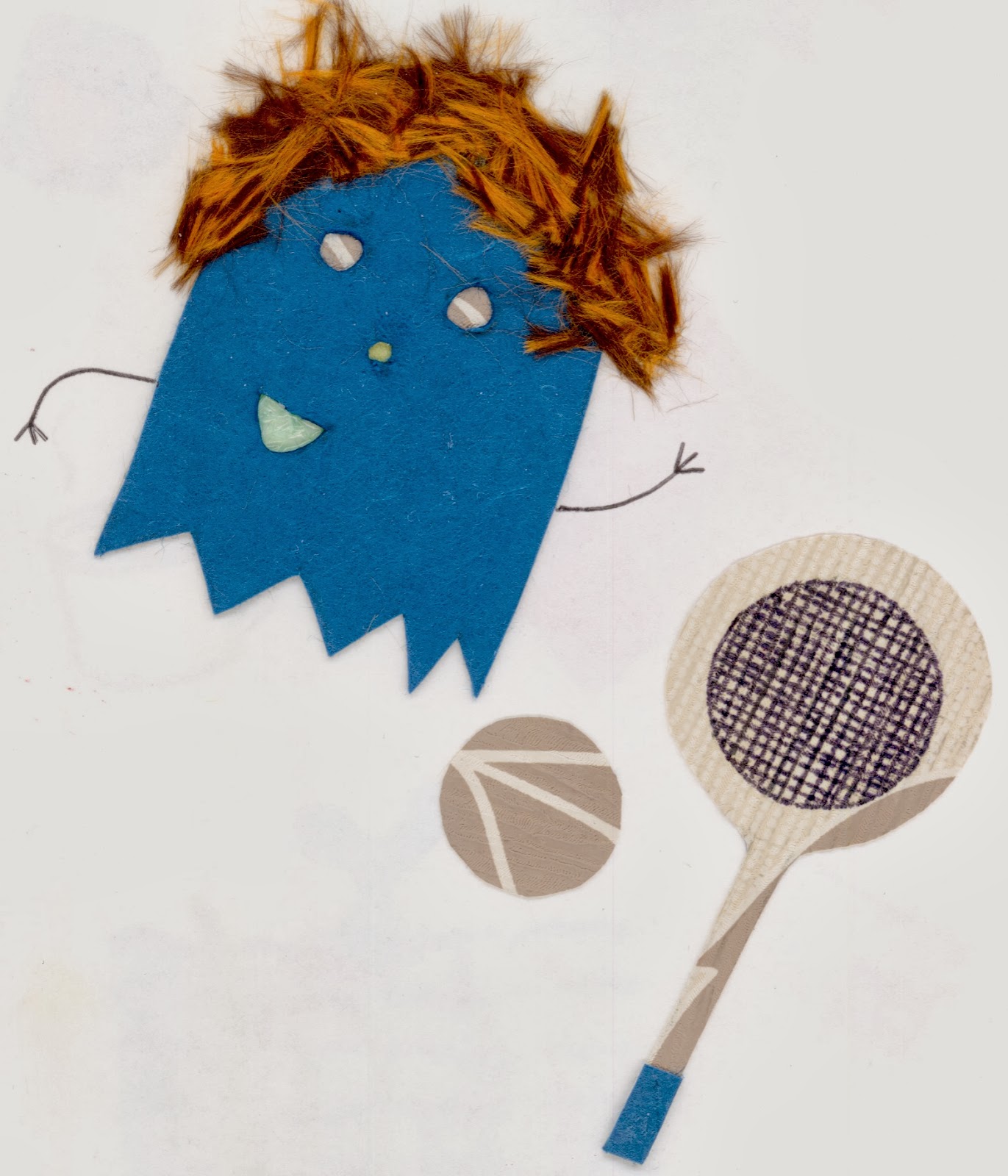
Geoffrey Bink with his tennis racket

Water colour Teepee that the Bink family live in near a river

I then came up with a story for my family, aiming at children ages 5 - 8 years of age. However I need a scary character/s that will make my story more interesting trying to represent fear and darkness within my work however not to scary as I don't wont to frighten children that much.

Here are some compositions I have created exploring the technique of ion printing to give my scary tree monster more of an edge as well as my work looking more sophisticated.

Original Sketch of the Tree monster

Collage of female tree monster

Collage of Male tree monster

Experimenting with Lino printing to give my character more of an edge.


Saturday, 28 September 2013

Guru Night!

Mentor - Rosie Wilman

Rosie has just recently Graduated from Stockport college with a 2:1 in Illustration that she has been studying for three years which is what I am in the process of as I'm in my third year now. Rosie loves producing illustrations for children and hopes to be a children's book illustrator .

Here is a link to see her website:        Rosie Wilman

Rosie gave me lots of advice and an insight into what working with an agent is all about.She has had many agents some nicer than others sometimes they make you work to a shorter deadline so have to work faster but this might mean the outcome of your work may look great. Rosie has created a few children's books that I think look great!
Sometimes your agent might change things and might print out differently - in some cases you may have to stand your ground and in the end your agent might like the choices you made!

Here are some of Rosie's work;


Another tip she gave me is that if you raise money for DND and agencies will help get you known by fundraising.

Rosie also gave me a few other artists to look at that might help me throughout my practise and influences throughout my art ethic of collage and mark making, such as Holly Mcloughlin whom creates fairy collages.

Here are a few images of Holly's Work;


Her work is so spine - tingling its fantastic it fills me with such Joy and an emotion of admiration, the composition's she creates are so imaginative, I can see the great connection this would have with children.

Here is a link to her website:           Holly Mcloughlin


Another artist Rosie suggested is an artist and illustrator called Sara Fanelli, she works with collage, typography and  playing around with layout exploring interweaving different objects with a variety of items she might use. Her work is very playful consisting of other various formats she may use throughout her work like etching, drawing, printmaking, cutting up things and finding various marks or making her own to project throughout her work. I have bought her book ' Sometimes I think, sometimes I am' it has a lot of fantastic unusual quotes referenced by various artists which most of them link to each different composition on the page giving the image more meaning. This book has helped me in the way I perceive the materials I use and to find similar mark makings to help me throughout my own practise.

Here are some electrifying compositions that I just think are outstanding;


This image I feel is very similar to Holly Mcloughlin.


Here is a link to a fabulous website about her:            Sara Fanelli

Wednesday, 25 September 2013

Lecture with Ian Whadcock!

Ian Whadcock is an illustrator, designer and educator he has worked in many things such as, magazines, politics, financial advertisements etc.

                                                          This is Ian Whadcock

Here are some examples of his work!


Ian talked about commissions he has done and gave a lot of great tips and advice for instance;

  • you need to feel confident in making the right decisions for the right reasons.
  • you have to be open to receive criticism 
  • Be diverse don't keep to the same style as it might weigh you down, you can have a vast range of styles that you like to work with such as drawing, collaging, painting etc. 
  • your career when you leave uni can change throughout the years taking different paths, dipping in and out of commissions and maybe ending up going into teaching. 
  • Don't be frightened of taking risks as sometimes you need to take them to learn more. .Be open to the idea of change and being someone else. 
  • The only tool that is ever relevant is a pencil once you put pencil to paper your off, but if you don't jot down your ideas then your not going to get very far. 
  • If you get commissioned to illustrate a dull text don't reject it turn it into something beautiful. For instance; even though some projects might not seem exciting lots of people may see the work you've produced or buy it and the pay may be great. 
  • 'Drawing with scissors' is great for escaping traps you may fall into. (This quote also relates to Henri Matisse.) get to be curious! 
  • Quote by Ian Whadcock; ' Doodles can help be a great way for patterns or ideas and there not there for you to be playing with the materials but because the materials want you to play with them'. 
  • At times you have to be brave and stand up for yourself .There are times when you need influences but sometimes you just need to DO! .things that are dull maybe the best source of inspiration. 
  • photograph everything 
  • be always collecting , researching keeping an archive .have random likes 
  • be proud of what you do! .document your own journeys for fun you never know what may happen with them. 
  • Rewarding work that you could do is throughout volunteering it gives you a sense of achievement. Quote by Ian Whadcock; ' The Only thing Unique is YOU!........make your own world ...........be playful....' 


I'm hopefully going to take some of these pointers on board!

Monday, 2 September 2013

Hopes, Fears and Opportunities!

During a group discussion my tutors spoke to me and my peers about what we might expect for the future and to help us when we leave college, reflecting on our hopes and fears.
They gave us some really good pieces of advice, for example;
- you need to have Inner confidence especially when getting in touch with agencies and contacting people in the outside world.
- Try and have a structure, make sure you keep in touch with friends whom are also illustrators and are in the same position as you when they leave Uni.
- Stop worrying about marks , just relax and DO WORK!

I have quite a lot of hopes for the future, one of them is to succeed third year with a substantial amount of work that gives the WOW factor, something that makes people stop and actually take in what's going on throughout my images. I hope I can archive a 2:1 for my degree so I can maybe consider taking a teacher course as I love working with children observing them creating images throughout there free, playful innocent nature, learning more from them. One of the key things I would love to do is to create a children's book and maybe more. All this came from the inspiration and joy from my younger sibling Crystal whom is seven years old. Another hope I would like to grow and connect with is my inner confidence, as I am quite a shy person especially when it comes to presentations and interviews.

My fears for the future surround the capability of me not achieving my hopes for instance, failing my course in illustration, not having enough confidence to contact people especially talking to people in the industry. another one of my fears is messing up my twenty minute presentation for third year reflecting my progression of work and key influences represented throughout my Journal, as I'm always mega nervous. Another fear I have is being a unsuccessful illustrator and if ever chosen by an agent will be unable to make the deadline, I hope this will never happen and I will always meet the deadline but it does make me feel quite anxious.

I have been very lucky to come across some great opportunities in my life during my degree at Stockport college, as I got to have the experience of meeting people in the industry. For example meeting Rosie Wilman at Guru night. I also have opportunities in going to lectures of those who are in the art industry and are out there making a success of themselves exploring the challenges they have faced throughout their career's. Another opportunity I have had is learning about myself more and investigating what I am capable of throughout my own practise learning new skills and techniques and learning more about my inner child that is portrayed throughout the reflection of my journal.

My aims for the future is to engage with more people in the industry, to find out about more lectures and events that are happening, I also aim to be more academic when doing my writing trying to be more professional. Another aim I wish to achieve is to maybe share a studio with other illustrators or graphic designers when I leave Stockport college and experience working together on different projects we may come across or just helping each other out.

Objectives
My objectives are to hopefully attend all seven lectures by different speakers this semester at Stockport College. Also to attend a few more events that are happening outside of college. Another objective is to research and find out how much studios cost and how much prionters, photo-shop,  illustrator and indesign costs. Maybe once I've found a good group of people to work with we could split the cost between us for computers  and printers.
My Plan of Action
  • Email and contact people in the industry.
  • Research and explore key events and be more involved.
  • Research, plan and be optimistic.
  • Try and save as much money as I can for the future.

Timetable of Action

Key lectures

Monday 1st July - Owt Creative, David Baily, Malcolm Garrett, Craig Oldham

Tuesday 24th September - Speaker Ian Whadcock

Tuesday 29th October - Illustrator Holly Wales

Tuesday 3rd December - Founder of Dwelle, Ric Frankland

Tuesday 14th January - Design/culture writer, Robert Urquhart

Tuesday 28th January - Manchester Holden and sons studio

Tuesday 18th February - Morton Newspaper printers, Steve Scott

Tuesday 25th March - Paper passionist, Deborah Wigglesworth


Wednesday, 7 August 2013

Summer Project-Level 6

Beyond the book                             Scary Stories

In level 6 I am asked to work on a self directed project to find my own stance on themes which are more open to interpretation. I naturally went towards an authorstrator approach coming up with my own ideas and themes constructing them together. I chose to explore the word of Scary stories inventing my own story with random unusual characters that live a spontaneous world where on monsters exist there are no humans represented.

I started researching various scary nursery rhymes, films and books learning how children react to them exploring the mystical representations that they present communicating to an audience of how moral misbehaviour can have disastrous consequences. This made me think a lot about how we tell children these scary stories act so they do as they are told and listen to you when they are naughty and have done wrong.

Here are a few things I have been looking at as a starting point;

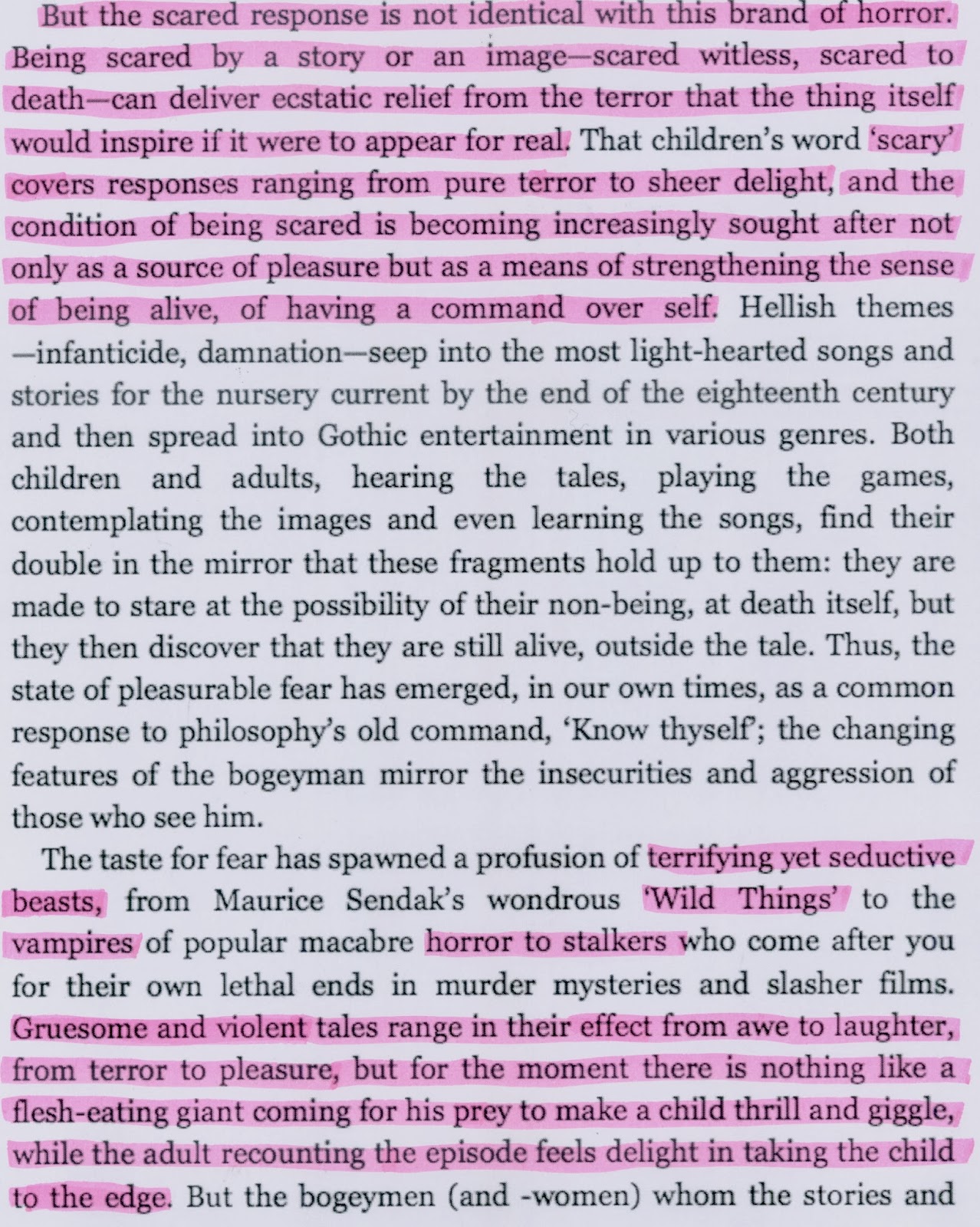
Marine Warner - No go the Bogeyman


Throughout these pages I have highlighted things that I feel are relevant that need to be explored further that are linked with fear and horror. This will also be used as reference to what has been influencing me throughout this project.


 Throughout Warners prologue of this book she has shown images that she has referenced as scary and what might children might fear.


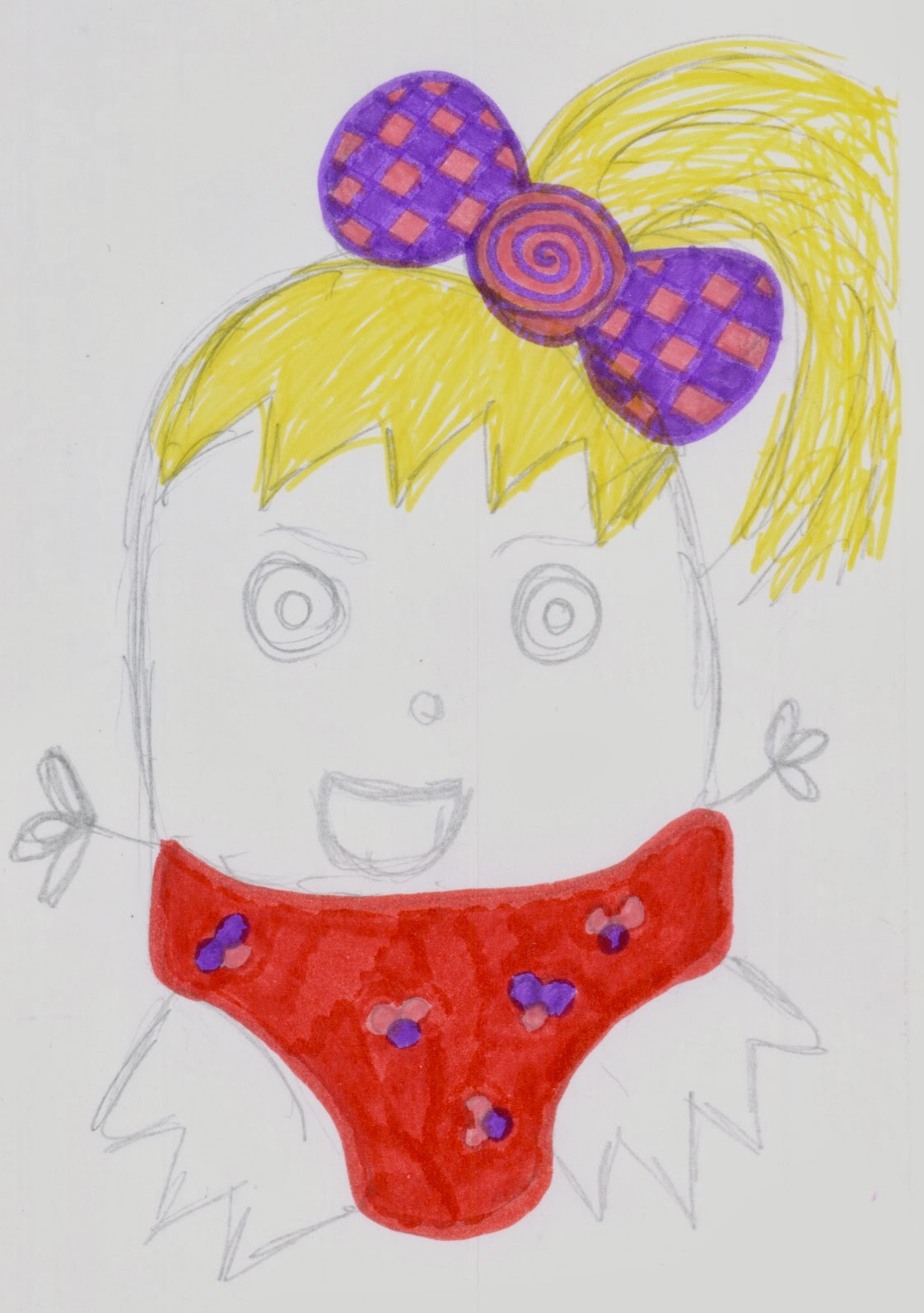
Here I have looked at images of what the bogeyman could look like also exploring nursery rhymes and the image next to it is a composition created by my 6 year old sister of her interpretation of the bogeyman.

 
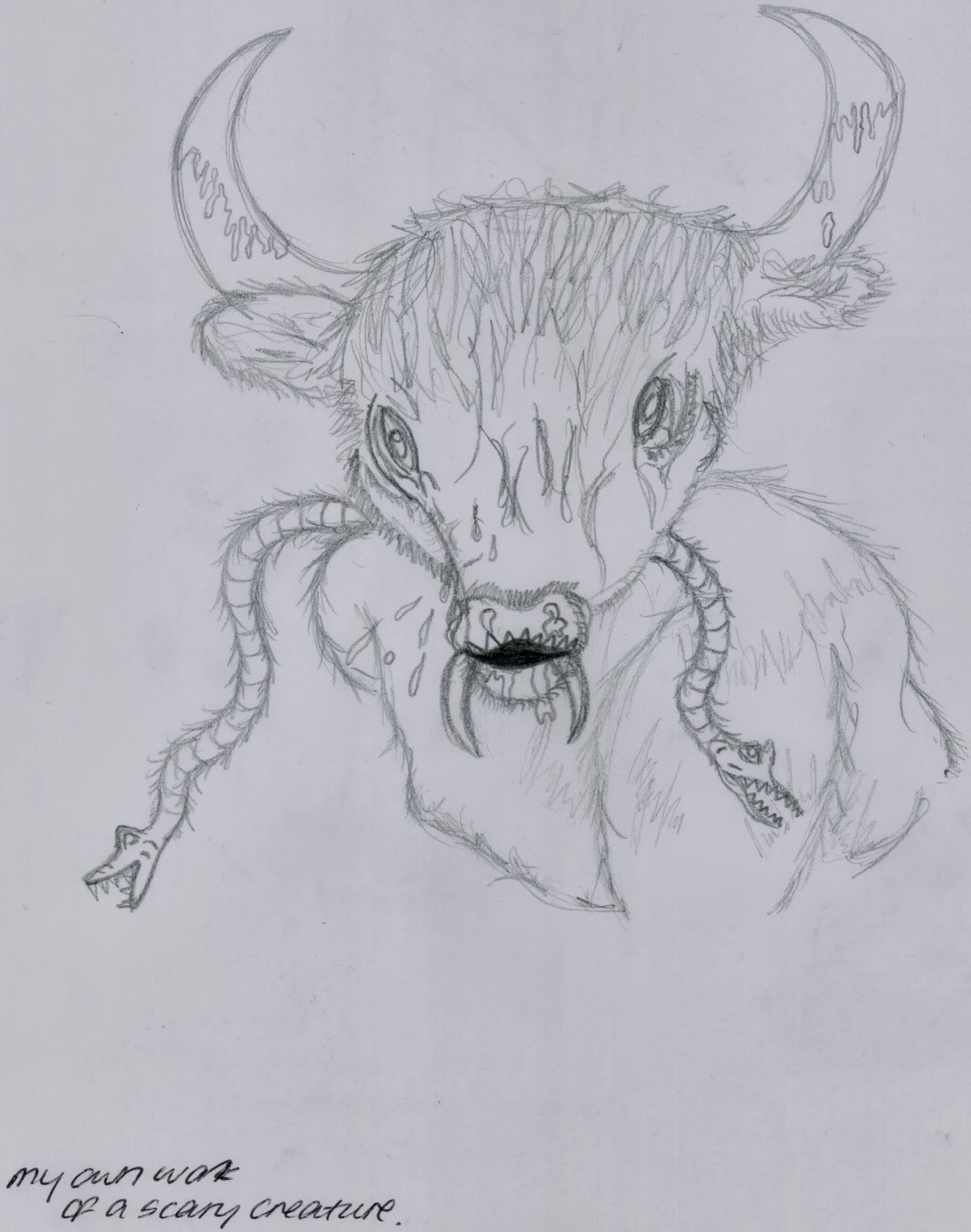
Here are a few of my images that I have created exploring scary creatures and creating animals then putting them together to create something new experimenting with hybridity. However I felt this wasn't going where I wanted it to go so tried a different approach.

 
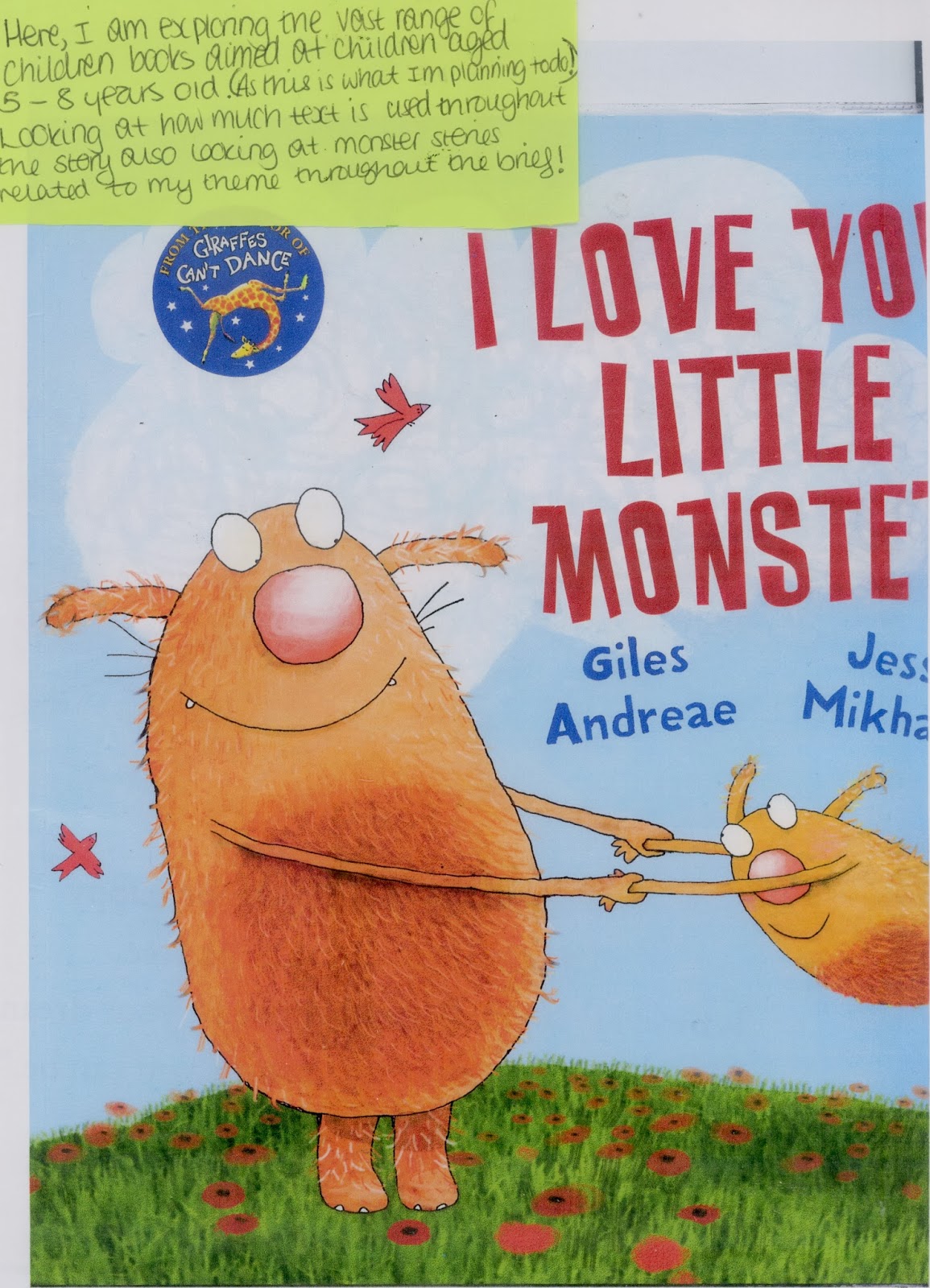
So I started investigating monster stories that were created as children's books for a new direction to attack this project. I Knew I wanted to use paper based materials throughout the use of collage but where to begin.

Here are a couple examples of children's books I looked at;

These are representations of friendly monsters!


This Book is called 'Eric' I found this creature very inspiring and unusual especially the viewpoints that a produced to make the audience feel how small he is exploring scale.